

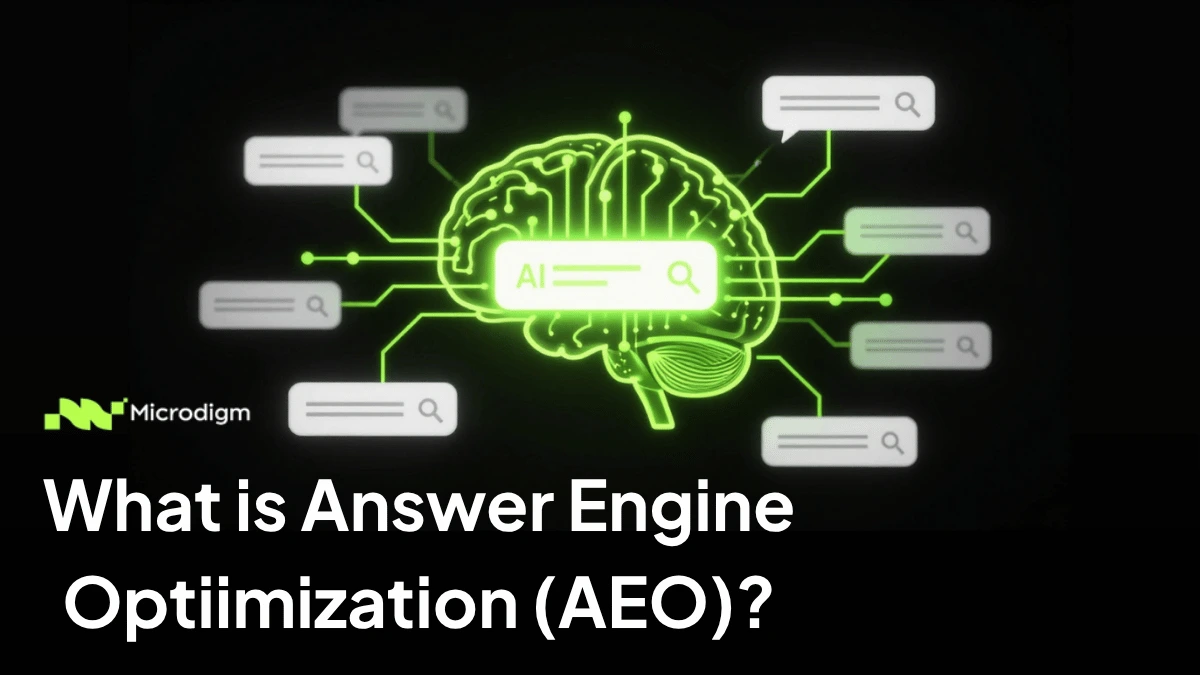
Search is no longer just about ranking. When someone asks ChatGPT, Perplexity, Google’s AI Overview, or Siri a question, they expect a direct answer — not a list of ten blue links. Answer Engine Optimization (AEO) is the practice of structuring your content so that AI systems and answer engines select your brand as the source of that answer.
What Is an Answer Engine?
An answer engine is any system that synthesizes a direct response to a query rather than returning a list of web pages. Examples include:
- Google AI Overviews — the generative summaries above organic results
- ChatGPT with Browse / GPT-4o — pulls from live web sources when browsing is enabled
- Perplexity AI — a dedicated AI search engine that cites sources inline
- Bing Copilot — Microsoft’s AI-powered search layer
- Voice assistants (Siri, Alexa, Google Assistant) — return one answer, no list
The difference between traditional SEO and AEO: SEO earns you a position in a list. AEO earns you the answer.
Why AEO Matters in 2025
Google’s AI Overviews now appear on roughly 47% of search queries in the US. Voice search accounts for a significant share of mobile queries. Users interacting with AI-powered chat interfaces expect a final answer, not a starting point for research.
If your content is not structured to answer questions directly, you are invisible in this new layer of search — even if you rank well in traditional blue-link results.
The businesses that benefit most are those whose content:
- Answers a specific question completely in one place
- Uses clear structure — headings, lists, short paragraphs
- Carries trust signals — schema markup, author credentials, citations
- Is accessible to AI crawlers (GPTBot, ClaudeBot, PerplexityBot)
AEO vs. SEO vs. GEO: What’s the Difference?
These three disciplines overlap but have distinct targets:
| Discipline | Optimizing For | Primary Signal |
|---|---|---|
| SEO | Google/Bing organic rankings | Backlinks, authority, technical health |
| AEO | AI Overviews, voice assistants, featured snippets | Direct-answer structure, schema, clarity |
| GEO | Generative AI tools (ChatGPT, Perplexity, Gemini) | Citations, entity mentions, trust signals |
In practice, a well-structured page serves all three. The disciplines reinforce each other.
How to Optimize Content for Answer Engines
1. Lead with the direct answer
Open every piece of content — especially blog posts and service pages — with a clear, concise answer to the question in the title. AI systems extract the first clear response they find.
Wrong: “In today’s digital landscape, businesses face many challenges when it comes to…”
Right: “Answer Engine Optimization (AEO) is the practice of structuring content so AI systems cite your brand as the source of a direct answer.”
2. Use structured headings as question formats
Frame your H2 and H3 headings as the questions your audience actually asks. This directly signals to answer engines what each section addresses.
- ✅ “What Is Answer Engine Optimization?”
- ✅ “How Does AEO Differ from Traditional SEO?”
- ✅ “Why Do AI Systems Ignore Some Content?”
- ❌ “Introduction to AEO Concepts”
3. Add FAQ and HowTo schema markup
JSON-LD structured data is machine-readable metadata that tells answer engines exactly what your content covers. FAQPage schema is particularly powerful — Google uses it directly for AI Overviews.
{
  "@type": "FAQPage",
  "mainEntity": [
    {
      "@type": "Question",
      "name": "What is AEO?",
      "acceptedAnswer": {
        "@type": "Answer",
        "text": "AEO is the practice of..."
      }
    }
  ]
}
4. Allow AI crawlers in your robots.txt
Many brands accidentally block the very crawlers that power AI answer engines. Your robots.txt should explicitly allow:
GPTBot(ChatGPT/OpenAI)ClaudeBot(Anthropic/Claude)PerplexityBotAnthropic-AIGooglebot-Extended(AI Overviews)
5. Build entity authority
AI systems cross-reference information across sources. If your brand, team members, and services appear consistently across your website, LinkedIn, Google Business Profile, and industry directories, the AI has more evidence to treat you as a trusted entity.
AEO Checklist for Your Next Blog Post
Before publishing, verify:
- Title is a question or implies one
- First 2–3 sentences directly answer the title question
- H2s are phrased as sub-questions users would ask
- At least one list or table for scannable facts
-
FAQPageorHowToschema added where relevant - Author name and credentials visible on page
- No AI crawler blocked in
robots.txt
How Microdigm Approaches AEO
Microdigm provides Answer Engine Optimization services for businesses that want their brand cited — not just ranked — in AI-driven search. Our process covers content restructuring, schema implementation, entity building, and crawler access audits.
If your content is losing visibility to AI Overviews or failing to appear in AI-generated answers, contact our team to discuss an AEO audit.