Publishing more content is not a strategy. In 2026, it is easier than ever to create large volumes of acceptable text. That makes generic content less defensible, not more valuable.
A stronger content strategy decides which customer questions the business is qualified to answer, how individual pages fit together, what original evidence the brand can add, and how content contributes to discovery, evaluation, conversion, and retention.
Start with customer decisions
Build the content plan from interviews, sales conversations, search queries, support questions, community discussions, objections, and lost-deal reasons. Keywords reveal language and demand. They do not replace customer understanding.
Map content to the customer journey: problem recognition, research, comparison, conversion, onboarding, and retention. Give every page a job.
Build topic architecture, not a keyword warehouse
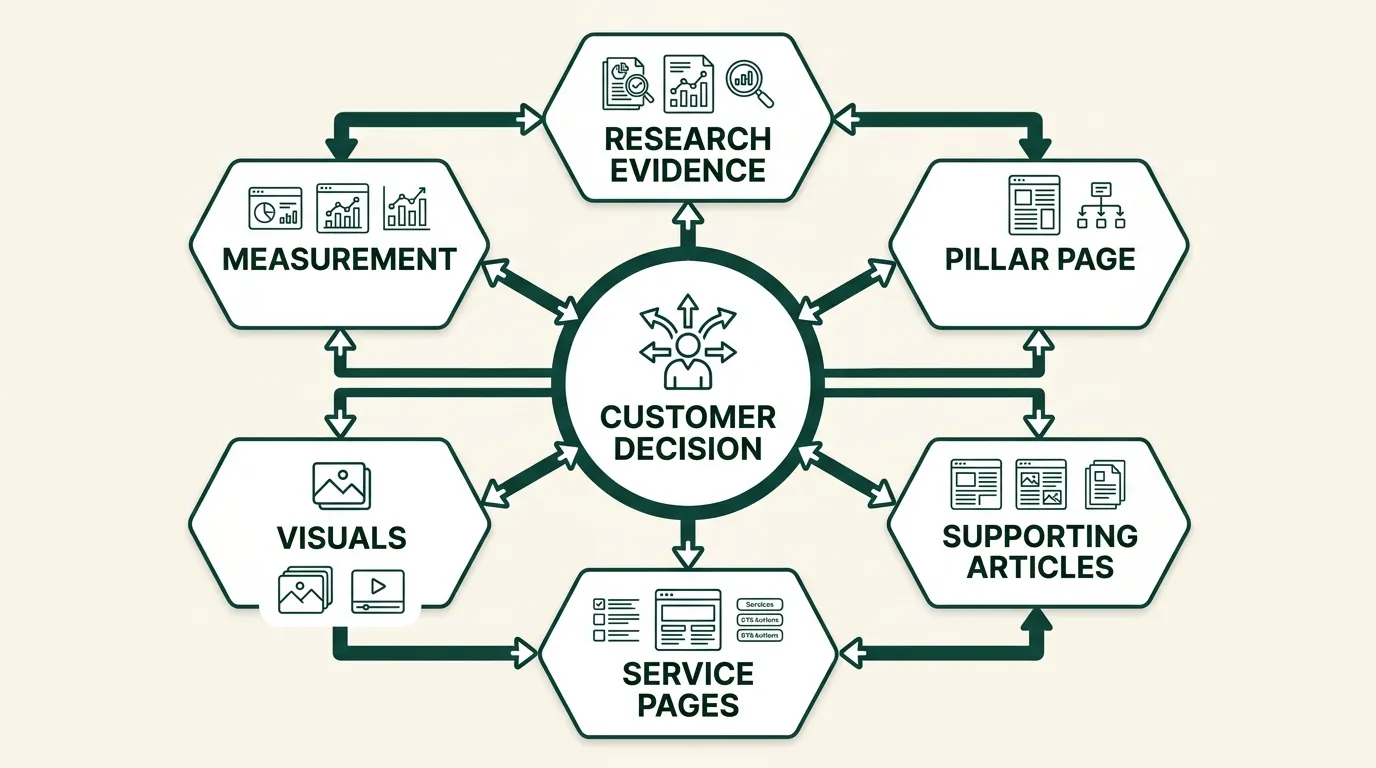
Choose a pillar topic that is commercially relevant and broad enough to support meaningful subtopics. Create supporting pages for distinct intents: definitions, comparisons, processes, templates, mistakes, use cases, and decision criteria.
For example, this Microdigm cluster uses digital strategy as the pillar and connects it to the digital audit, 90-day roadmap, customer journey map, SEO vs PPC, and measurement framework.
Avoid creating several pages that answer the same question with minor keyword variations. Overlap makes internal linking confusing and can blur which URL should represent the intent.
AEO-friendly structure helps readers too. Lead important sections with a concise answer. Use descriptive question headings where natural. Follow the answer with context, exceptions, examples, and decisions.
Use tables only for real comparisons. Use numbered steps for sequences. Add definitions close to the terms they explain. Keep important facts in visible text rather than placing them only in images.
Do not repeat the same summary every few paragraphs. Clarity is not mechanical redundancy.
Add original expertise and evidence
Generative tools can help organize research and identify gaps. They cannot manufacture legitimate first-party experience. Add:
- Expert commentary tied to a named reviewer
- Original frameworks that are clearly identified as proposed or used
- Anonymized examples only when genuinely based on documented work
- Screenshots, templates, calculations, or process artifacts
- Primary-source references for changing facts
- Clear limitations and counterarguments
Never invent client outcomes, quotes, studies, or credentials. Google’s guidance warns that scaled AI-generated pages without added value may violate spam policies.
Design internal links as editorial guidance
Every important page should receive contextual links from related pages. Use descriptive anchor text that tells the reader what to expect. Link pillars to supporting articles, articles back to pillars, and informational content to relevant service or proof pages when the next step is natural.
For example, a guide about search discovery can link to Microdigm’s SEO services, AI SEO services, and AEO services. Do not place all links in a repetitive footer block and call that strategy.
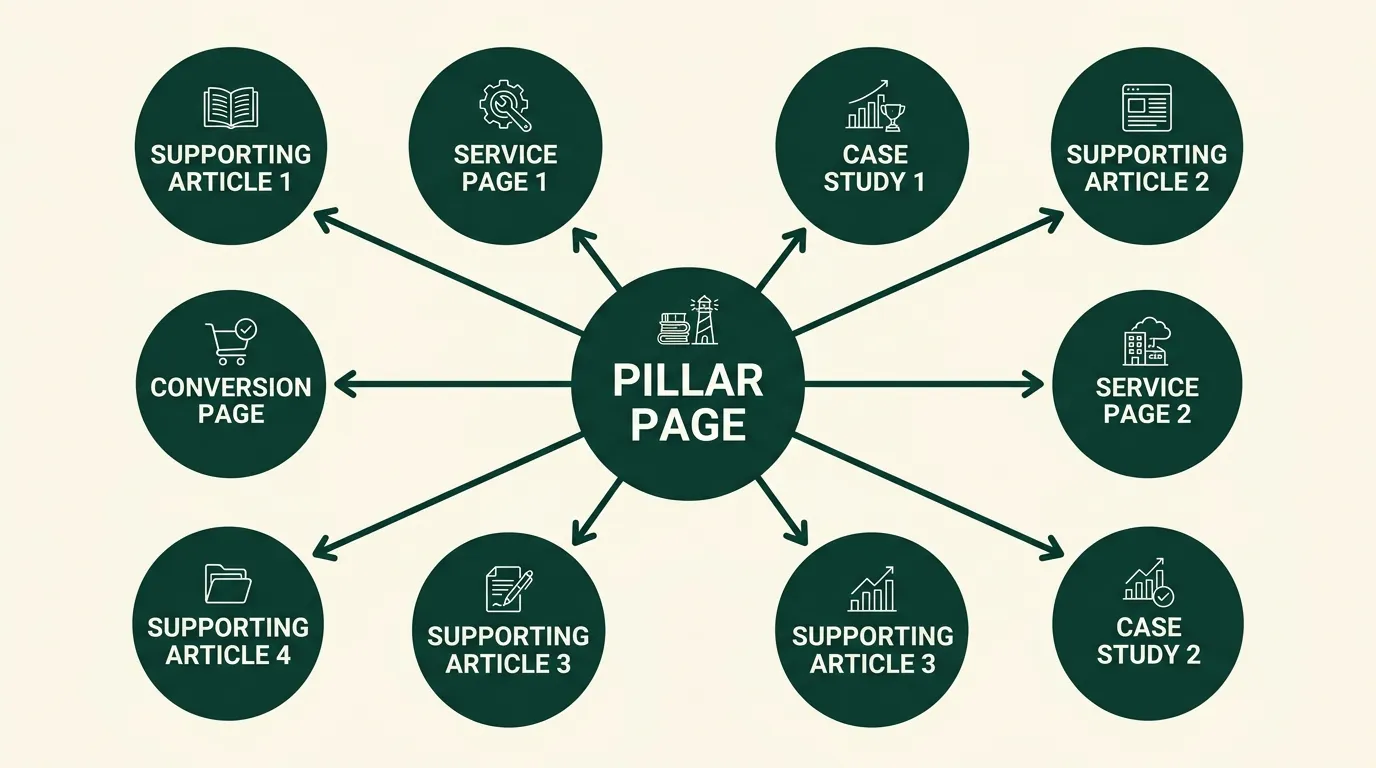
Use diagrams, process maps, comparison visuals, checklists, screenshots, and original charts when they make the idea easier to understand. Add descriptive alt text and captions. Keep decorative images secondary.
If AI generates the starting visual, manually typeset labels, verify every depicted relationship, and keep a consistent brand palette. Do not publish garbled text or a diagram that looks precise but says nothing.
Use structured data accurately
Add BlogPosting and BreadcrumbList markup that matches visible content. Include real author and publisher details, canonical URL, publication and truthful modification dates, and representative images.
FAQ markup is not a guaranteed rich-result tactic. HowTo rich results have been removed by Google. There is no special AEO or GEO schema. Structured data helps machines understand declared entities and content types, but it does not replace quality or indexing.
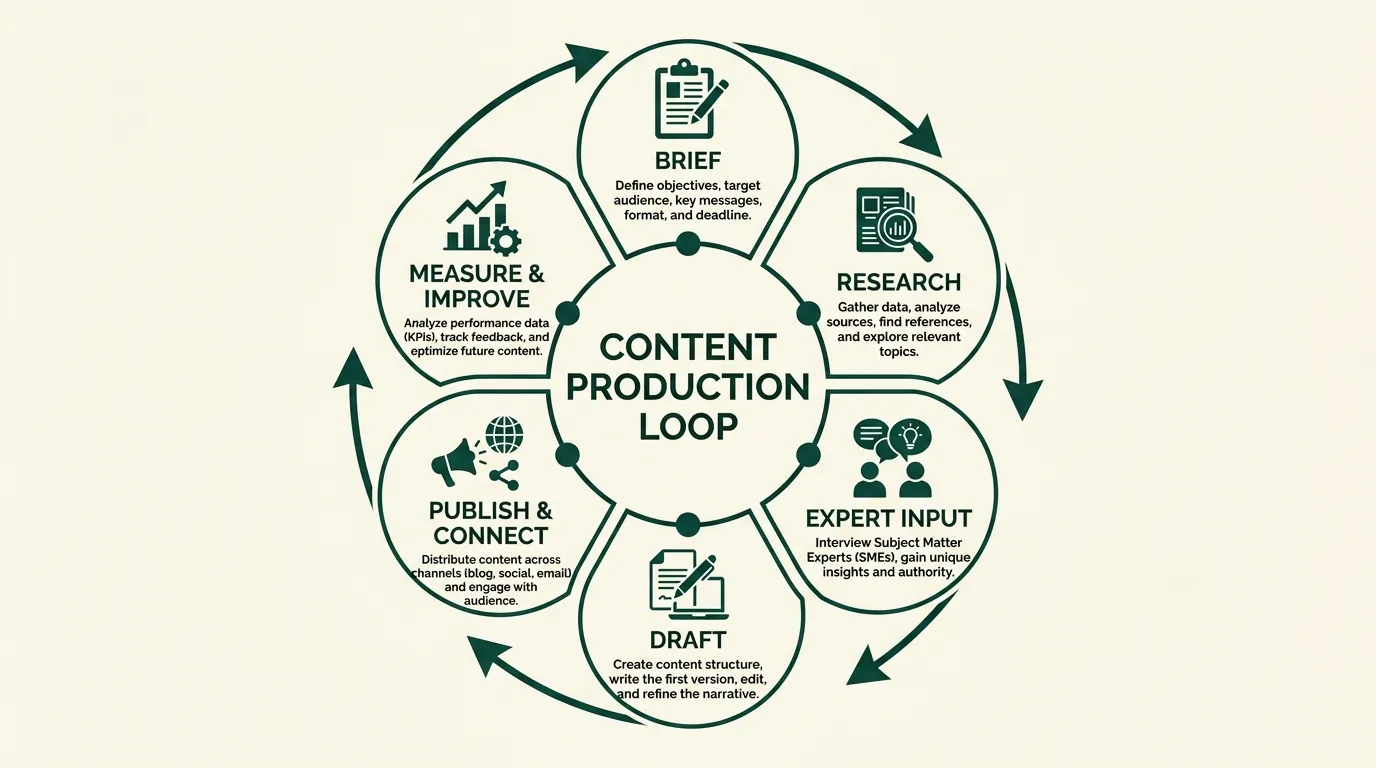
A practical production workflow
1. Brief
Define intent, audience, business role, primary query, related entities, differentiation, sources, internal links, visuals, and conversion goal.
2. Research
Review primary sources, customer evidence, current results, competitors, and existing site content. Record what the article must add.
Interview the subject-matter expert before drafting or route specific questions for review. Capture language, examples, caveats, and disagreement.
4. Draft and edit
Answer the core question early. Build depth around decisions. Remove generic claims, filler, and unsupported certainty.
5. Publish and connect
Add metadata, schema, visuals, internal links, sitemap entry, and truthful update date. Link from existing relevant pages.
6. Measure and improve
Track non-brand visibility, qualified visits, conversions, backlinks, sales use, and AI citations where available. Refresh when facts, intent, or customer needs change, not just when the calendar changes.
Content quality checklist
- One page owns one primary intent.
- The answer appears early and is understandable alone.
- The article adds real expertise, evidence, or utility.
- Claims that can change use current primary sources.
- Internal anchors are descriptive and helpful.
- Images explain something and include alt text.
- Author and update information are truthful.
- Structured data matches visible content.
- The article has a clear business role and next step.
- Performance is reviewed beyond rankings alone.
Frequently asked questions
Is AI-generated content bad for SEO?
Not automatically. Google focuses on quality and value, not the production tool. Scaled content created mainly to manipulate rankings, without original value, can violate spam policies.
Does GEO replace SEO?
No. Generative discovery still depends heavily on crawlable, indexable, understandable, and credible web content. GEO adds attention to citation, evidence, entity clarity, and representation.
How long should an SEO article be?
Long enough to satisfy the intent and support the decision. Word count is not a quality target. A short definition and a detailed implementation guide need different depth.
Build fewer, stronger content systems
Explore Microdigm’s content marketing services, AI SEO, and AEO services, or request a content strategy discussion.
Editorial sources
Use these primary or authoritative sources to verify changeable claims before publication. They are editorial references, not a substitute for Microdigm’s own expert review.