The question “Should we invest in SEO or PPC?” is incomplete. The useful question is: which mix gives this business the best balance of speed, learning, efficiency, control, and durable demand capture?
SEO and PPC can compete for budget, but they can also improve each other. Paid search reveals commercial queries and message responses quickly. Organic search can reduce long-term dependence on paying for every visit. Both fail when the offer, landing experience, tracking, or lead follow-up is weak.
SEO and PPC compared
SEO earns visibility through crawlable, useful pages, technical quality, relevance, internal linking, and authority. PPC pays for placement under platform rules and auction economics. SEO normally takes longer to establish but can create durable discovery. PPC can launch quickly but stops producing traffic when it stops.
Neither channel is free. SEO requires research, technical work, content marketing, expertise, digital PR, and maintenance. PPC requires media spend plus campaign, creative, landing-page, analytics, and optimization work.
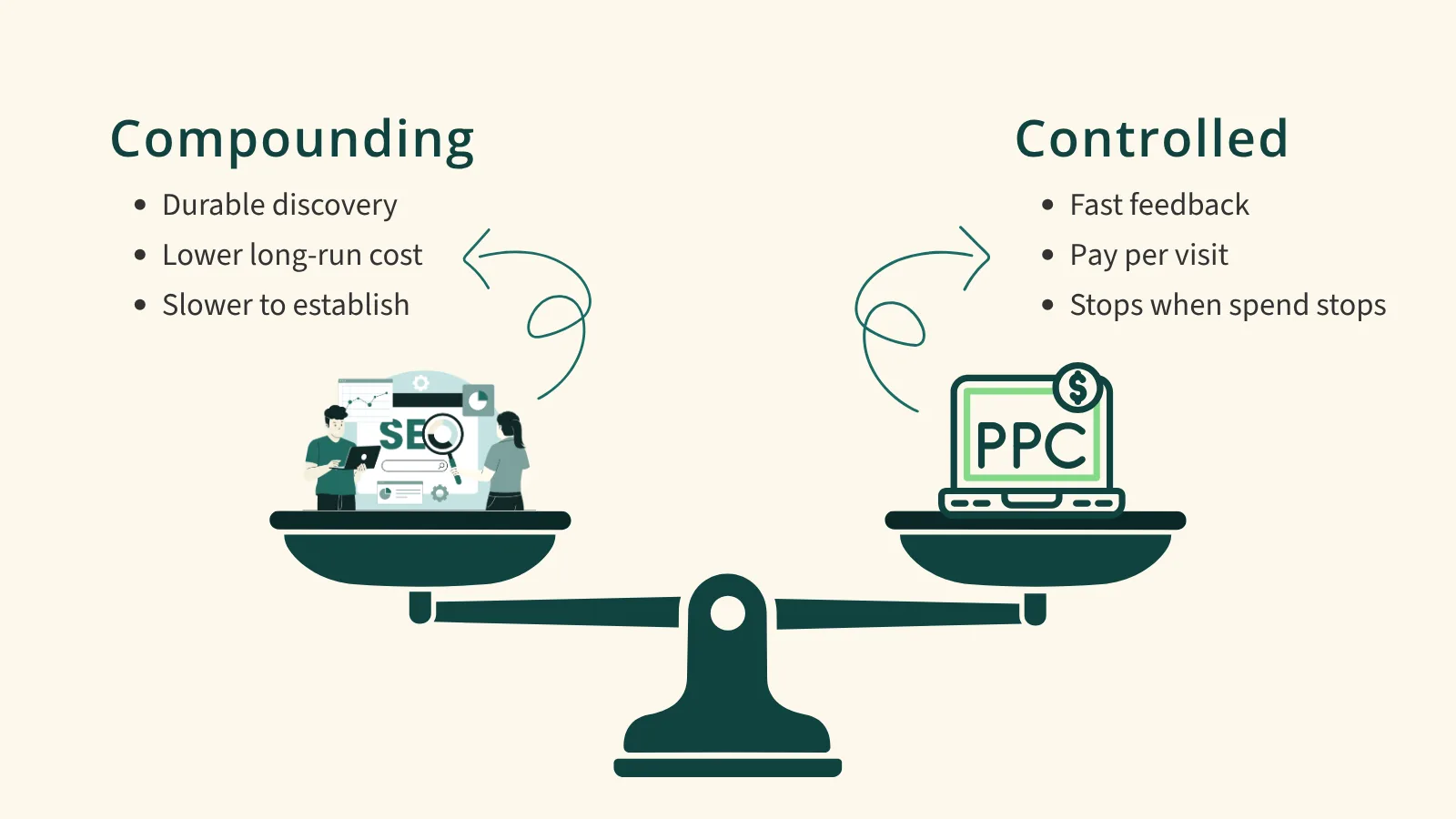
Choose SEO when
- Customers repeatedly search for durable problems, categories, comparisons, or solutions.
- The business can invest consistently for several months.
- Organic visibility can support multiple stages of the customer journey.
- The website can publish and maintain genuinely useful content.
- Reducing dependence on paid acquisition is strategically important.
Start with a technical and content baseline. Microdigm’s SEO services focus on compounding organic growth. Review the common SEO mistakes that limit organic performance before assuming content volume is the main constraint.
Choose PPC when
- The business needs faster demand and feedback.
- High-intent searches exist and unit economics can support the auction.
- The offer, landing page, tracking, and follow-up are ready.
- The business needs controlled tests by location, audience, message, or service.
- Seasonal or time-sensitive demand matters.
Use Microdigm’s PPC services where cleaner acquisition efficiency is the goal. Conversion quality and commercial outcomes matter more than platform-reported return on ad spend alone.
Use both when the roles are clear
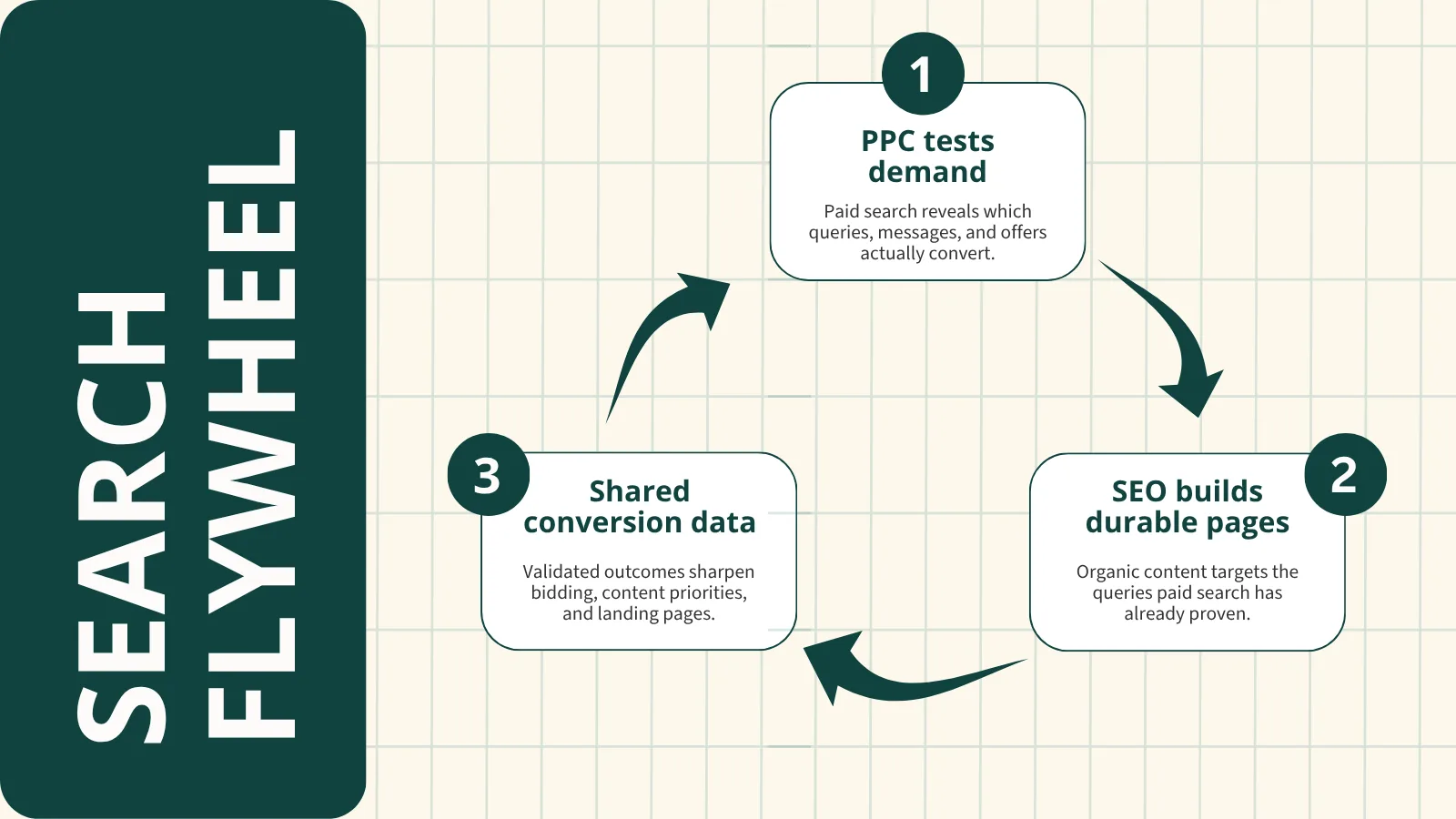
A combined strategy can use PPC to capture high-intent demand and test messages while SEO develops durable coverage. Search-term and conversion data can inform organic priorities. Strong organic pages can improve landing-page relevance and reduce duplicated production effort.
Do not make the channels duplicate each other blindly. Some queries deserve paid coverage, organic coverage, or both. Others have weak commercial value regardless of volume.
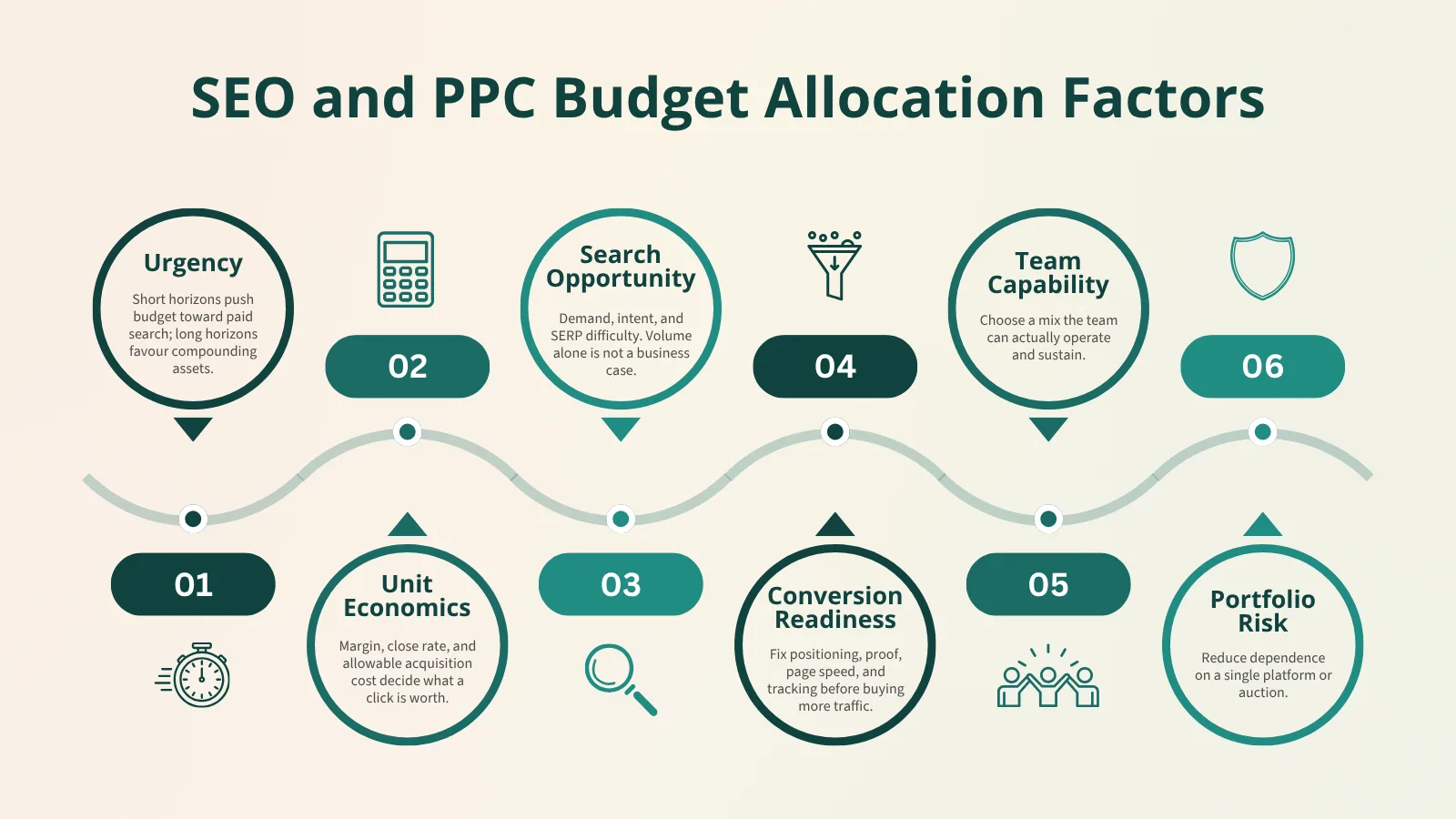
A six-factor budget allocation framework
1. Urgency
If the business needs qualified demand within weeks, allocate more to paid search while building the organic foundation. If the horizon is longer, invest more in compounding assets. A 90-day digital strategy roadmap helps set that horizon before the money moves.
2. Unit economics
Calculate gross margin, close rate, average order or contract value, refund or churn risk, and allowable acquisition cost. A high click cost can still be viable for a strong-margin offer. Cheap clicks can be wasteful when lead quality is poor.
3. Search opportunity
Evaluate demand, intent, SERP composition, competitive strength, topic depth, and the business’s ability to provide something better. Search volume alone is not a business case.
4. Conversion readiness
Do not buy more traffic into unclear positioning, weak proof, slow pages, broken tracking, or unreliable follow-up. A digital audit should expose those issues first.
5. Team capability
SEO requires sustained editorial, technical, and authority-building work. PPC requires active budget control, query review, creative testing, tracking, and landing-page iteration. Choose a mix the team can operate well.
6. Portfolio risk
Overdependence on one platform increases risk. Organic visibility can reduce auction dependence. Paid media can protect demand during ranking volatility or while organic work matures.
Example allocation scenarios
New B2B service entering a market
Use paid search to test high-intent queries and offers, while building a small organic cluster around customer problems and evaluation questions. Prioritize tracking and sales feedback because low lead volumes can make early conclusions unreliable.
Established e-commerce store
Use PPC for product and seasonal demand where margins support it. Invest in technical SEO, category architecture, product information, and editorial content that helps comparison and discovery. Measure contribution margin, not revenue alone.
Local professional service
Build local and service-page SEO for durable visibility. Use tightly targeted paid search for urgent or high-value services. Improve reviews, response time, and conversion paths because both channels depend on trust.
Measurement rules
Track business outcomes, qualified conversions, and diagnostic channel metrics. For SEO, monitor non-brand visibility, qualified landing-page visits, assisted conversions, and pipeline contribution. For PPC, monitor query quality, conversion accuracy, cost per qualified lead, close rate, and acquired margin.
Avoid comparing channels only by last-click conversions. Search, social, content, and direct visits can support one journey.
Common allocation mistakes
- Treating SEO as free traffic.
- Treating PPC as instant profit.
- Using platform conversions without CRM validation.
- Funding traffic before fixing landing pages.
- Publishing SEO content without expertise or internal links.
- Pausing organic work as soon as PPC performs.
- Spreading a small budget across too many campaigns and topics.
Frequently asked questions
Is SEO better than PPC?
Not universally. SEO is stronger for durable organic discovery; PPC is stronger for controlled speed and testing. The better choice depends on economics, urgency, demand, competition, and execution quality.
What percentage of budget should go to SEO?
There is no defensible universal percentage. Allocate by expected value, time horizon, portfolio risk, and the business’s ability to execute. Revisit the mix as evidence improves.
Can PPC help SEO rankings?
Buying ads does not directly purchase organic rankings. PPC can produce query, message, and conversion insights that improve organic strategy, while better organic content can improve shared landing experiences.
Build a search portfolio, not a channel rivalry
Review Microdigm’s SEO services and PPC services, then discuss a search investment plan based on your margins, urgency, and measurement readiness.