Businesses often run SEO, paid ads, social media, email, and automation at the same time and still have no digital strategy. Activity is not a strategy. Strategy explains what the business is trying to change, which customers matter, why they should choose the offer, how digital channels will work together, and what evidence will guide the next decision.
That distinction matters in 2026 because discovery is fragmented across search engines, AI-generated answers, social platforms, marketplaces, communities, and direct recommendations. Teams have more tools and output than they can realistically use. The shortage is coherence.
What is a digital strategy?
A digital strategy is the logic connecting a business goal to the digital capabilities required to achieve it. “Increase revenue” is a goal, not a strategy. “Post more on social media” is an activity, not a strategy. A useful strategy identifies the market, audience, offer, discovery model, conversion path, operating requirements, and measurement plan.
Microdigm offers a broad mix of digital marketing and web development services. The strategy must decide which combination deserves attention now. Otherwise, a service menu becomes an undisciplined to-do list.

Digital marketing strategy focuses on how a business creates and captures demand through channels such as search, content, paid media, social, and email. Digital strategy is broader: it connects those channels to the website, customer journey, data, automation, and operating process. Digital transformation is broader again and may change the company’s business model, roles, processes, and technology.
Use the smallest scope that solves the real problem. A company does not need a transformation programme every time it needs stronger acquisition or a better website.
The seven-layer digital strategy framework
1. Business outcome and constraints
Choose one primary outcome for the planning period: qualified pipeline, profitable revenue, retention, market entry, or lower cost to serve. Add a number, deadline, owner, and known constraints. If fulfillment cannot handle more orders, acquisition is not the first problem.
2. Customer and demand reality
Use customer interviews, sales notes, search queries, CRM data, win-loss reasons, support questions, and competitor positioning. The objective is not a decorative persona. It is to understand the decisions a buyer must make. A structured digital audit helps separate evidence from internal assumptions.
3. Offer and positioning
Clarify who the offer is for, what costly problem it solves, what outcome the buyer receives, and why the buyer should believe the promise. More traffic cannot repair an offer that is difficult to understand or trust.
4. Journey and digital experience
Map problem recognition, research, comparison, conversion, onboarding, delivery, retention, and referral. At every stage, identify the buyer’s question, proof requirement, useful content, next action, and responsible owner. Customer journey mapping turns this into an operating tool.
5. Channel portfolio and content
Give every channel a job. SEO services can build compounding discovery, PPC services can capture active demand and accelerate learning, and content marketing can support both. Do not expect every channel to generate awareness, leads, trust, sales, and retention independently.
6. Data, technology, and operations
Map analytics, consent, CRM stages, lead routing, campaign data, reporting, customer communication, and quality control. Workflow automation is valuable when it improves a defined process. Automating confusion only makes it move faster.
7. Measurement, experimentation, and governance
Separate business outcomes, decision indicators, and channel signals. Define who reviews them, how often decisions are made, and what threshold triggers action. The marketing measurement framework explains this hierarchy in detail.

Turn the strategy into a 90-day plan
During days 1 to 30, diagnose the business outcome, customer evidence, website, channels, content, tracking, and CRM flow. During days 31 to 45, fix critical tracking and conversion gaps and build the required assets. During days 46 to 60, launch a controlled first version and monitor early signals. During days 61 to 90, compare results with assumptions, improve messages and journeys, and decide what to scale, stop, or test.
The full 90-day digital strategy roadmap includes priorities and review checkpoints. Limit work in progress. Twenty simultaneous priorities are a backlog, not a strategy.
How SEO, AEO, and GEO fit together
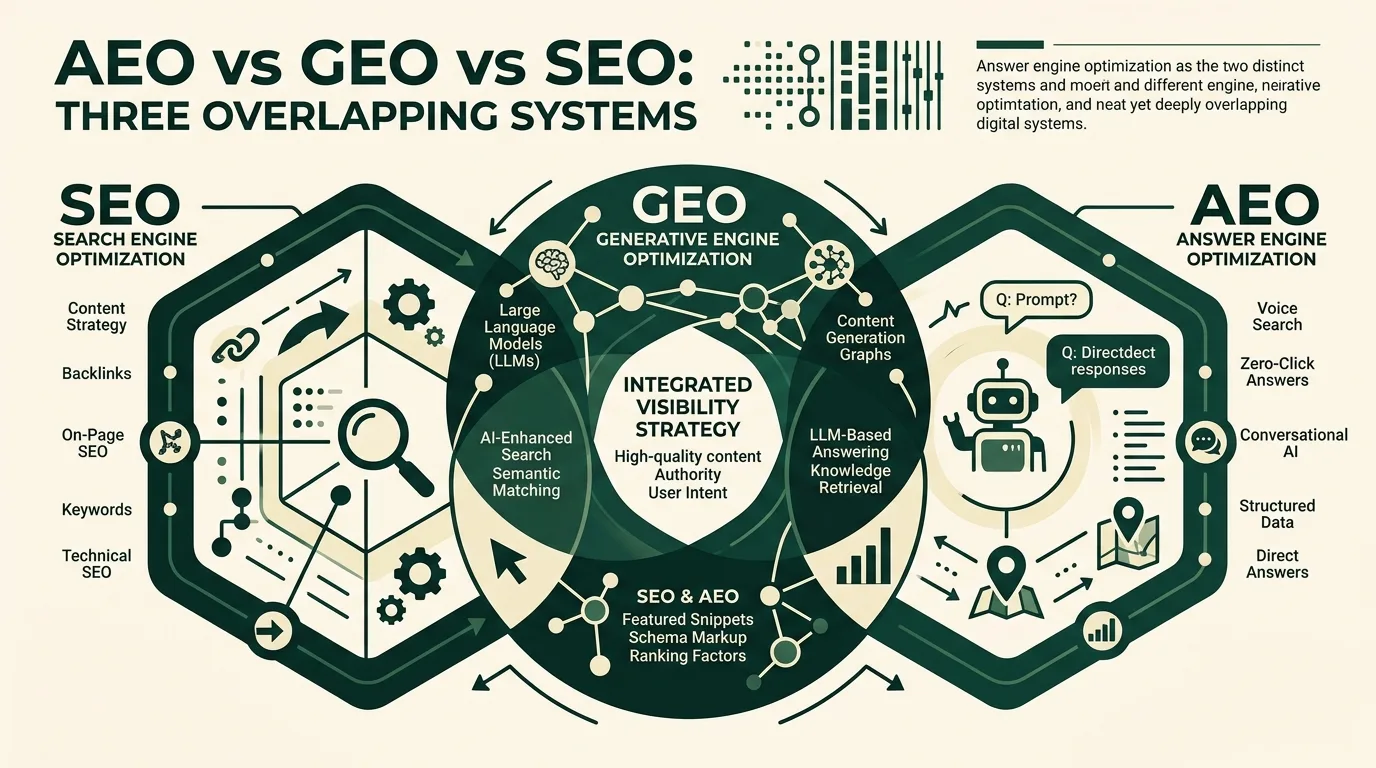
SEO provides the technical and editorial foundation for discovery. AEO makes answers clear and easy to extract for question-led experiences. GEO improves the clarity, evidence, consistency, and entity signals that can help generative systems represent or cite a brand accurately.
These disciplines overlap. Google’s current guidance says generative search visibility still depends on strong SEO foundations rather than special “AI schema.” Microdigm should build one discovery system, then measure conventional search performance and AI citations. Read our guide on AEO vs GEO vs SEO for a practical operating model.
Why digital strategies fail
- They start with channels before diagnosing the business problem.
- They treat every audience as a priority.
- They confuse content volume with authority.
- They measure activity without connecting it to customer or business value.
- They buy tools before defining the process.
- They automate weak, unreviewed work.
- They keep the strategy in a presentation instead of weekly decisions.

Digital strategy checklist
- One primary business outcome has a number, deadline, and owner.
- The main constraint is documented.
- Customer and demand assumptions are supported by evidence.
- The offer and proof are consistent across channels.
- Every selected channel has a defined role.
- The website supports evaluation and conversion.
- Lead capture, CRM, and follow-up are connected.
- Business, decision, and channel metrics are defined.
- The roadmap states what the team will not do.
Frequently asked questions
What are the main components of a digital strategy?
The main components are the business outcome, customer insight, offer and positioning, digital journey, channel portfolio, data and technology system, and measurement and governance plan.
How often should a digital strategy be reviewed?
Review execution signals weekly, performance and resource allocation monthly, and strategic assumptions quarterly. Do not rewrite the whole strategy every week, but do not protect an assumption that evidence has disproved.
Can a small business build a digital strategy?
Yes. A small team should narrow the plan aggressively: one priority audience, one core offer, a small channel portfolio, reliable tracking, and disciplined follow-up.
Build a strategy your team can operate
A digital strategy should make execution clearer. It should tell the team which customer matters, which problem to solve, how channels and systems connect, what evidence matters, and what to stop doing. Review Microdigm’s representative case studies, client testimonials, and agency FAQs, then discuss your digital strategy.